
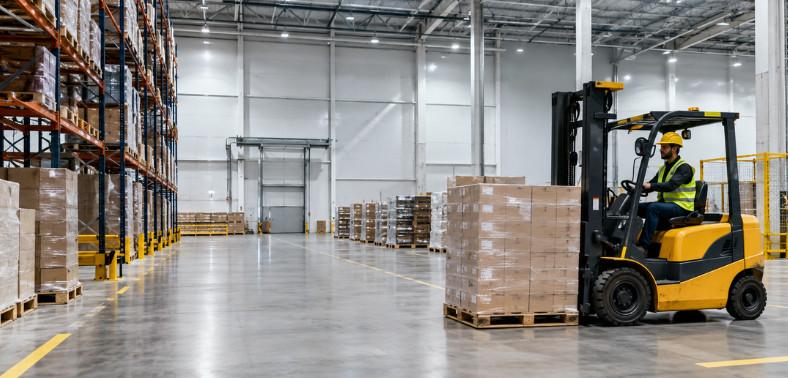
Every warehouse, port, factory, and mine runs on a fleet. Not a fleet of trucks traveling on public roads, but one made up of forklifts, reach trucks, terminal tractors, and yard equipment moving materials across the site, shift after shift.
Vehicle fleet management is the discipline that keeps those vehicles, their operators, and the data they generate working as one coordinated system. When it works, throughput holds. When it does not, costs rise across the operation in ways that are difficult to trace back to their source.
This guide explores the principles of industrial vehicle fleet management, the operational pillars that keep fleets running efficiently, the challenges organizations face, and the technologies enabling safer, more connected, and data-driven fleet operations.
JLT Mobile Computers has spent over three decades designing and engineering rugged computing hardware for warehouses, ports, manufacturing sites, cold storage facilities, and mines. Drawing on that experience, this guide examines the technologies and best practices that help industrial fleets operate more efficiently, reliably, and safely.
Understanding vehicle fleet management
What is vehicle fleet management?
Vehicle fleet management is the coordinated process of acquiring, deploying, maintaining, and monitoring a group of vehicles so they deliver consistent output at a predictable cost and an acceptable level of risk. It connects four things often managed in isolation: the vehicles, the people operating them, the maintenance keeping them available, and the data showing whether any of it is working.
The term covers two distinct disciplines. On-road fleet management deals with trucks and vans on public roads, where routing, fuel, and regulatory driving hours are the primary concerns. In-facility fleet management deals with vehicles operating within a defined site—a warehouse, distribution center, container terminal, or mine—where equipment availability, operator safety, and live connection to warehouse systems matter most. This guide focuses on the second. The vehicles, environments, and technologies differ enough that advice written for one rarely transfers to the other.
Why vehicle fleet management matters
An industrial vehicle fleet is typically one of the largest capital commitments on a site and sits directly in the path of every metric the operation is measured on.
Equipment downtime does not absorb itself. When a truck is unavailable, the work it was scheduled to do redistributes or queues, and the delay compounds across shifts. Maintenance, energy costs, damage to racking and product, surplus fleet capacity, and short-term hire to cover breakdowns all accumulate below the headline purchase figure. Fleet management is largely the work of finding and closing those gaps before they become embedded costs.
Risk is the other dimension. Powered industrial trucks operate close to people, and incidents tend to be serious. Managing operator certification, pre-use inspection, access control, and impact monitoring is both a safety obligation and, in most jurisdictions, a regulatory requirement.
Industries that depend on industrial fleet management
Warehousing and distribution run dense, varied fleets across receiving, storage, picking, and dispatch. Fleet performance translates almost directly into order accuracy and on-time dispatch.
Ports and container terminals operate high-value equipment around the clock against vessel and gate schedules, where a single unavailable machine has immediate knock-on costs.
Manufacturing ties fleet performance to line continuity. Materials arrive and finished goods leave on a production rhythm that does not pause for an unplanned repair.
Cold storage adds a thermal constraint. Equipment repeatedly crosses between freezer and ambient zones, creating specific demands on batteries, sealed electronics, and displays.
Mining and heavy industry subject fleets to the harshest duty cycles: abrasive dust, vibration, moisture, and difficult maintenance access in remote or underground environments.
The operational pillars of industrial vehicle fleet management
Fleet visibility and asset tracking
Visibility means knowing what equipment the site holds, where it is, what condition it is in, and what it is currently doing. Many operations can answer the first question from a finance record and struggle with the rest.
Inside steel-framed buildings and cold stores, satellite positioning is unreliable. Location data for in-facility fleets comes from Wi-Fi infrastructure, zone-level readers, or the task record itself—a truck confirming a pick in an aisle has effectively reported its position. The more valuable output is utilization: productive hours versus idle time per unit and how demand is distributed across shifts and zones. This is what exposes a fleet that has grown quietly without deliberate planning, and the department running surplus trucks while another runs short.
Operator management, safety, and compliance
Powered industrial truck operation requires formal training and documented evaluation. In the United States, OSHA mandates operator training, evaluation and re-evaluation at least every three years, with additional retraining after incidents, near misses, or a change of equipment type.
Access control restricts each vehicle to qualified operators and produces an accurate log of who operated which unit and when. Pre-use inspections identify defects before a truck enters a live operation. When results are captured digitally, defects reach the maintenance team immediately rather than sitting in a folder until someone reviews them at the week’s end.
Impact sensors and speed monitoring shift safety management from reactive investigation to early intervention. A pattern of low-level impacts in one area typically reveals a layout or congestion problem—a distinction that only becomes visible when events are recorded consistently.
Maintenance, reliability, and downtime prevention
Reactive maintenance repairs after failure. It is unavoidable in part but expensive as a strategy, because failures happen mid-shift without staged parts or planned cover.
Preventive maintenance works at fixed intervals of time or hours. It is a significant improvement, though its limitation is that intervals are averages. A truck running double shifts in a harsh outdoor yard and one running light duty in a clean aisle receive identical treatment.
Predictive maintenance uses condition data from the vehicle—hour meters, fault codes, battery state, temperature, vibration—to service equipment based on its actual state. It converts unplanned stoppages into planned ones, which is where most of the financial benefit sits. A planned intervention happens between shifts with the right parts available, rather than mid-operation. This approach depends entirely on continuous, reliable data from the vehicle, which means the hardware fitted to the truck determines what predictive maintenance can actually achieve.
Fleet data, kpis, and operational intelligence
A workable metric set covers four areas:
- Availability: fleet availability, unplanned downtime hours, mean time between failures, and mean time to repair
- Utilisation: productive hours versus key-on time, movements per hour, utilisation by shift and zone
- Cost: maintenance cost per unit per hour, energy cost per unit, and total cost of ownership
- Safety: impact events per shift, inspection completion rates, defects raised and resolved, operator certification currency
Data that depends on manual entry degrades under operational pressure. Capturing metrics as a by-product of work already being done, through in-vehicle devices connected to warehouse systems, is what makes a reporting discipline sustainable.
Common challenges and how to address them
Rising costs and unplanned downtime
Fleet cost rarely arrives as a single increase. It accumulates through maintenance on equipment kept past its economic life, short-term hire covering breakdowns, overtime recovering lost output, and damage to racking and product that sits outside the fleet cost report entirely. Unplanned downtime is the most expensive single driver, because it charges twice: the repair and the surrounding operational disruption. Progress comes from tracking the total cost of ownership per unit, right-sizing fleet numbers against measured utilization, and shifting maintenance spend from reactive to planned.
Harsh operating conditions
Industrial fleets work in conditions that commercial-grade equipment is not designed to survive. Vibration from uneven concrete, expansion joints, and dock plates is continuous and cumulative. Equipment for vehicle mounting is qualified against standards such as MIL-STD-810 for precisely this reason.
Dust, moisture, and washdown require sealed enclosures rated to recognized ingress protection standards. Cold storage adds condensation cycling: equipment moving repeatedly between a freezer aisle and an ambient dock collects moisture internally, causing corrosion and display fogging in hardware not designed for the transition. Displays must remain readable across dim aisles and full outdoor sunlight. Interfaces must be operable with gloves. Wireless sessions must hold as vehicles move continuously through steel racking and dense stock.
Manual processes and disconnected systems
The most common obstacle is not equipment; it is a fleet operated through paper and spreadsheets, with vehicle data, maintenance records, safety events, and warehouse systems in separate places that do not communicate.
Standardizing and digitizing fleet processes addresses this at the source. Start with mandatory workflows such as pre-use inspections and defect reporting, as compliance gives the change traction.
Capture at the point of work using in-vehicle hardware. Connect results to the systems that act on them, so a defect creates a maintenance task automatically. Consistent capture then produces the reliable data that predictive maintenance and accurate fleet sizing both depend on.
Discover rugged computing solutions built for industrial fleet operations.
The technology stack behind modern industrial fleets
Rugged vehicle-mounted computers and industrial tablets
The device on the vehicle is where fleet management becomes operational. Three categories are in common use and they are not interchangeable.
Rugged vehicle-mounted computers are permanently installed on the vehicle and powered from the vehicle’s supply, built for continuous shift-long use. No independent battery to manage, no device to account for between shifts. JLT’s vehicle-mounted computer range, including the JLT6012 series, is built specifically for this role; it is engineered for the vibration, temperature extremes, and wireless demands of industrial vehicle operations.
Forklift-mounted tablets are tablet-form devices on a mounting dock or cradle that allow removal when work moves between the vehicle and the floor. A forklift-mounted tablet manages its own battery between docking, must withstand being carried and dropped as well as ridden, and introduces device management questions a fixed installation does not.
It is a distinct product category from a rugged vehicle-mounted computer, and choosing between them should follow how the work is actually performed.
Rugged handhelds are carried for tasks away from the vehicle, receiving checks, cycle counts, and inventory queries, and complement vehicle-mounted equipment rather than replacing it.
Specification questions are consistent across all three: vibration and shock tolerance, dust and moisture sealing, temperature and condensation resistance, display readability across the full lighting range of the site, gloved-hand usability, and wireless session stability while moving.
For a detailed breakdown of vehicle-mount computer use cases, specifications, and ROI, see Rugged Industrial Computers for Vehicles: What Are Vehicle-Mount Computers.
Telematics, iot, and connected fleet data
Telematics turns individual vehicles into reporting assets. For in-facility fleets, the relevant data includes hour meters, fault codes, battery state, impact events, operator identity, inspection results, and zone-level position from site infrastructure.
The value depends on integration: telematics reporting into its own portal, separate from maintenance and warehouse systems, creates another silo. The benefit appears when a fault code or failed inspection automatically triggers action in the system managing the work.
Barcode, rfid, and integration with WMS and ERP
Scanning makes a movement verifiable rather than assumed. Integrated barcode imagers confirm location, pallet, and quantity at the point of work, so the system records what happened rather than what was planned. RFID adds throughput where individual scanning is impractical: full-pallet portal reads, yard and dock reads, and asset tagging for attachments and returnable containers.
A vehicle device connected to the WMS receives directed tasks and returns confirmations in real time; linked onward to ERP, those movements update inventory and order records. The core requirement is consistent: a stable wireless session across the whole site, with reliable handling of brief coverage gaps so no transaction is lost mid-operation.
Where industrial fleet management is heading
Automated guided vehicles and autonomous mobile robots are increasingly deployed alongside manned trucks, making mixed-fleet coordination—shared traffic rules and task allocation between manned and unmanned equipment—a management requirement in its own right.
Edge computing moves more decision-making to the vehicle, running safety alerts and operational logic locally and reducing dependence on continuous network coverage. Electrification is making energy a managed fleet input, with battery lifecycle and energy consumption per movement entering standard fleet reporting.
Assistive safety systems such as pedestrian detection, blind-corner alerts, and load monitoring are becoming more common, adding to what can be prevented rather than investigated after the fact.
Purpose-Built Rugged Computing for Industrial Fleets
Getting the hardware right is where reliable fleet management starts. JLT Mobile Computers builds rugged in-vehicle computing solutions used across warehouses, ports, manufacturing sites, cold storage facilities, and mines—environments where the cost of a device failing is never just the device. If you are evaluating your fleet’s specific computing requirements, the JLT team can help identify the right rugged computing solution for your operational environment.
Key takeaways
Vehicle fleet management in industrial operations connects vehicles, operators, maintenance, and data into a single working system. Its results show in throughput, cost, and safety.
Four pillars carry a program: visibility, operator management, maintenance, and operational data. Weakness in any one limits the others.
Most fleet cost accumulates below the purchase figure—in downtime, surplus capacity, damage, and equipment kept past its economic life—and becomes manageable only once it is measured.
The device on the vehicle is the foundation. Rugged vehicle-mounted computers, forklift-mounted tablets, and rugged handhelds are distinct categories serving different working patterns. Specifying correctly for the environment and the work determines whether everything built on top of it performs.
Digitizing and standardizing fleet processes produces the consistent data that predictive maintenance, right-sized fleets, and credible performance reporting all depend on.