
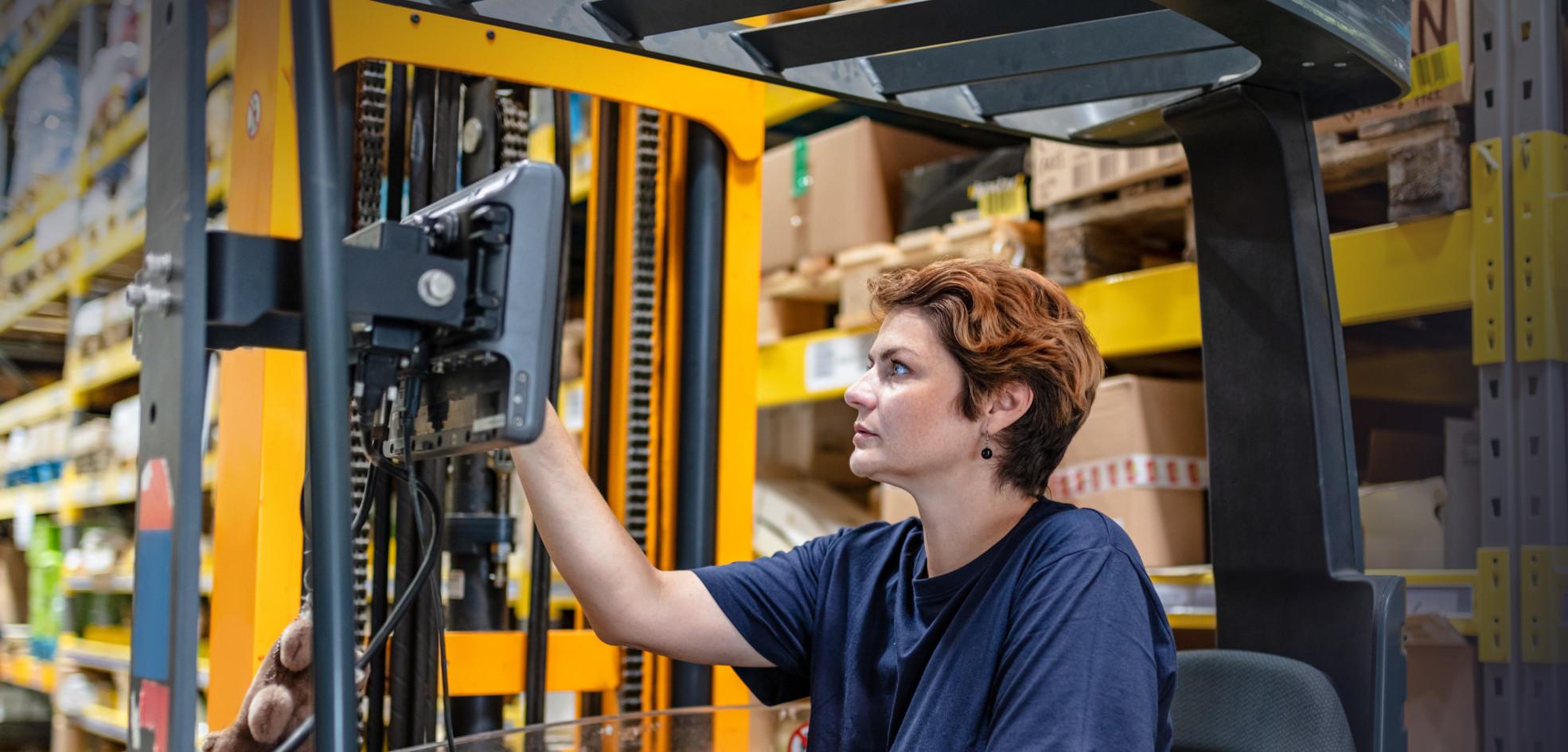
Unplanned downtime and manual inefficiencies can cost industrial and logistics organizations millions in lost productivity. In these environments, real-time access to operational data is critical for keeping people, equipment, and workflows moving.
Vehicle-mount computers are specialized rugged industrial computers designed for use on forklifts, trucks, cranes, and other industrial vehicles. Unlike consumer-grade devices, they are built to withstand dust, extreme temperatures, vibration, moisture, and continuous operation.
From warehouses and distribution centers to ports, manufacturing facilities, and cold-storage environments, these systems give operators access to the information and applications they need without leaving their vehicles.
What are vehicle-mount computers?
Vehicle-mount computers are rugged computing devices permanently or semi-permanently installed on industrial vehicles. They provide operators with access to business applications, inventory data, work orders, navigation, and other operational information directly from the vehicle.
Key characteristics include:
- Rugged design: Shock- and vibration-resistant construction with protection against dust and water, including IP65/IP67 options.
- Display options: Industrial displays ranging from compact screens to larger 21-inch formats, with sunlight-readable and glove-operable options.
- Operational efficiency: Real-time access to scanning workflows, warehouse management systems, production applications, and other critical software.
By placing computing capabilities directly where work happens, these devices can reduce unnecessary movement and help operators complete tasks more efficiently.
Vehicle-mount vs. other rugged industrial computing systems
Not every rugged computer is designed for use on a moving industrial vehicle. Vehicle-mounted systems are engineered around the specific requirements of mobile industrial operations.
| Feature | Vehicle-Mounted Systems | Other Rugged Computers |
|---|---|---|
| Mobility | Fixed to a vehicle | Stationary, handheld, or carried |
| Shock and vibration | Designed for high levels of vibration and shock | Varies by device |
| Power | Vehicle power or UPS | Facility power or battery |
| Typical Use Cases | Forklifts, trucks, cranes | Workstations, tablets, handheld devices |
The right platform depends on the workflow, vehicle, environment, and applications being used. A purpose-built system can provide a more reliable fit than adapting a general-purpose device to an industrial vehicle.
Where vehicle-mounted computers create the most value
These rugged computing systems support a wide range of industrial workflows.
Warehousing and distribution
In warehouses and distribution centers, operators can use vehicle-mounted devices for:
- Picking and put-away
- Inventory management
- Barcode scanning
- Order fulfillment
- Real-time warehouse management system access
Providing information directly at the forklift or other material-handling vehicle can reduce travel time and help operators work with fewer interruptions.
Logistics and transportation
Transportation operations depend on timely information. Rugged vehicle computers can give drivers and operators access to:
- Live route information
- Work orders
- Shipment status
- Delivery information
- Communication and dispatch applications
This helps connect mobile equipment with the systems managing the wider operation.
Manufacturing shop floors
On manufacturing floors, rugged computers can connect operators and vehicles to manufacturing execution systems (MES), production data, quality-control applications, and traceability workflows.
The ability to access information at the point of work can help reduce manual data entry and improve visibility across production processes.
Cold storage and harsh environments
Freezer aisles and other temperature-controlled environments place additional demands on industrial hardware. Purpose-built systems can be designed to operate in low temperatures while handling moisture, vibration, and frequent use with gloves.
This makes rugged vehicle computing particularly valuable for cold-chain warehouses and other demanding environments.
Ports and port terminals
Ports require computing equipment that can withstand outdoor exposure, vibration, dust, and demanding vehicle operations.
Rugged vehicle-mounted systems can connect terminal operators to applications used for container handling, yard management, equipment coordination, and other port workflows.
Critical features and specifications
Choosing an industrial computer requires more than simply selecting a screen size or processor. The device needs to match the operating environment, vehicle, software, and connectivity requirements.
Displays
Display size, brightness, resolution, viewing angle, and touch technology all affect usability. Sunlight-readable displays can improve visibility in outdoor environments, while glove-operable interfaces are important in warehouses, cold storage, and other settings where operators may not be able to remove their gloves.
Processing power
The processor and memory configuration should be matched to the applications running on the system. Simple workflows may require modest computing resources, while systems running demanding enterprise applications or multiple processes may require higher performance.
Connectivity
Reliable connectivity is essential when operational data needs to move continuously between vehicles and central systems. Depending on the application, connectivity options may include:
- Wi-Fi
- 4G/5G WWAN
- Bluetooth
- GPS
- Ethernet
Durability
Industrial vehicles expose computers to vibration, shock, dust, moisture, temperature changes, and other environmental stresses. IP65/IP67 protection and rugged construction can help systems continue operating in these conditions.
Power and mounting
Vehicle-mounted equipment needs to integrate with the vehicle’s electrical system and physical layout. Features such as ignition sensing, UPS capabilities, vehicle-specific mounting, and appropriate power ranges can help ensure dependable operation.
Accessories
Mounting systems, keyboards, scanners, cables, docking equipment, and other peripherals should work as part of the overall solution. Properly matched accessories can simplify installation and help maintain reliability throughout the device lifecycle.
Why businesses invest: operational benefits and measurable ROI
The value of rugged vehicle computing goes beyond hardware specifications. When properly integrated into industrial workflows, these systems can support measurable operational improvements.
Higher productivity
Operators can access information and applications without repeatedly leaving their vehicles or returning to fixed workstations. This can reduce unnecessary movement and support faster task completion.
Improved accuracy
Real-time access to inventory, work orders, production data, and other data can reduce manual processes and help minimize data-entry errors.
Enhanced operational safety
Keeping information available at the point of work can reduce unnecessary movement between vehicles and workstations. Compact vehicle-specific designs can also help maintain visibility and reduce operator distraction.
Lower total cost of ownership
A rugged system designed for industrial use can reduce the replacement and maintenance costs associated with consumer-grade hardware that is not designed for continuous exposure to harsh operating conditions.
When evaluating ROI, organizations should consider not only the initial hardware investment but also productivity, downtime, maintenance, replacement cycles, deployment costs, and long-term support.
Challenges and mitigation
Industrial vehicle computing comes with unique challenges, but purpose-built systems can help address them.
Environmental stress
Vibration, shock, temperature extremes, dust, and moisture can affect hardware performance. Rugged construction and appropriate environmental ratings help reduce these risks.
Network reliability
Warehouses, yards, ports, and manufacturing environments can contain areas with inconsistent wireless coverage. Selecting appropriate wireless technologies and designing connectivity around the operating environment can improve reliability.
System compatibility
The computer needs to work with existing ERP, WMS, MES, fleet-management, and other enterprise applications. Compatibility should therefore be considered before deployment.
Mitigation strategies
A successful deployment starts with understanding the vehicle, workflow, operating environment, software, connectivity, and power requirements. Selecting hardware around these factors can help reduce operational disruptions and improve long-term performance.
Why JLT mobile computers fits mission-critical vehicle-based operations
JLT Mobile Computers develops rugged computing systems specifically for demanding industrial environments. Rather than taking a general-purpose computer and adapting it to a vehicle, JLT focuses on purpose-built platforms designed around the requirements of industrial operations.
This approach combines rugged hardware, vehicle integration, connectivity, lifecycle support, and application requirements to create a solution suited to the operational environment.
For organizations where downtime directly affects productivity, equipment availability and long-term support are important considerations alongside hardware specifications.
JLT vehicle-mounting solutions
JLT offers several rugged computing platforms designed for vehicle-based industrial operations.
Jlt6015 – 15.6-inch rugged computer
The JLT6015 combines a 15.6-inch Full HD display with a rugged platform designed for demanding industrial applications. It supports Windows 11 IoT Enterprise LTSC and optional 5G connectivity, with a sunlight-readable, glove-operable display.
Jlt6012a – 12-inch rugged computer
The JLT6012A is a compact 12-inch platform designed for demanding vehicle applications. It runs Android 12 with GMS and supports a 9–72 VDC power range. An optional keyboard and JLT Insights capabilities provide additional flexibility for industrial workflows.
JLT6012 – 12-inch rugged computer
The JLT6012 combines a compact form factor with Windows 10/11 IoT LTSC support. Its capacitive touch interface, including JLT PowerTouch technology, is designed for industrial use, while WWAN 4G/5G and Wi-Fi 6E provide flexible connectivity options.
VERSO series
The VERSO series is available in 10-, 12-, and 15-inch configurations. These ultra-rugged, dock-free computers use Intel Core i3/i7 processors and provide sunlight-readable displays. For port operations, VERSO platforms are also Navis Ready.
Future trends in vehicle-mount computing
Industrial vehicle computing continues to evolve as organizations look for more connected and data-driven operations.
Iot and predictive analytics
Connected equipment can generate operational data that organizations can use to identify trends, monitor performance, and support predictive maintenance strategies.
Edge computing
Processing information closer to where it is generated can reduce latency and support applications that require rapid access to operational data.
Ar and vr
Augmented and virtual reality technologies may support training, maintenance, visualization, and other workflows as industrial applications continue to develop.
AI and cloud integration
AI and cloud technologies can help organizations turn operational data into actionable insights while enabling greater coordination between vehicles, workers, equipment, and enterprise systems.
Conclusion
Rugged vehicle computing plays an important role in warehouses, logistics operations, manufacturing facilities, ports, cold-storage environments, and other demanding industrial settings. By putting reliable computing capabilities directly on industrial vehicles, organizations can improve productivity, accuracy, safety, and operational visibility.
JLT6015, JLT6012A, JLT6012, and the VERSO series provide different configurations for organizations with varying vehicle, workflow, connectivity, and application requirements.
Selecting the right platform is about more than hardware specifications. The solution needs to support long-term reliability, system availability, vehicle integration, and the organization’s broader operational goals.