
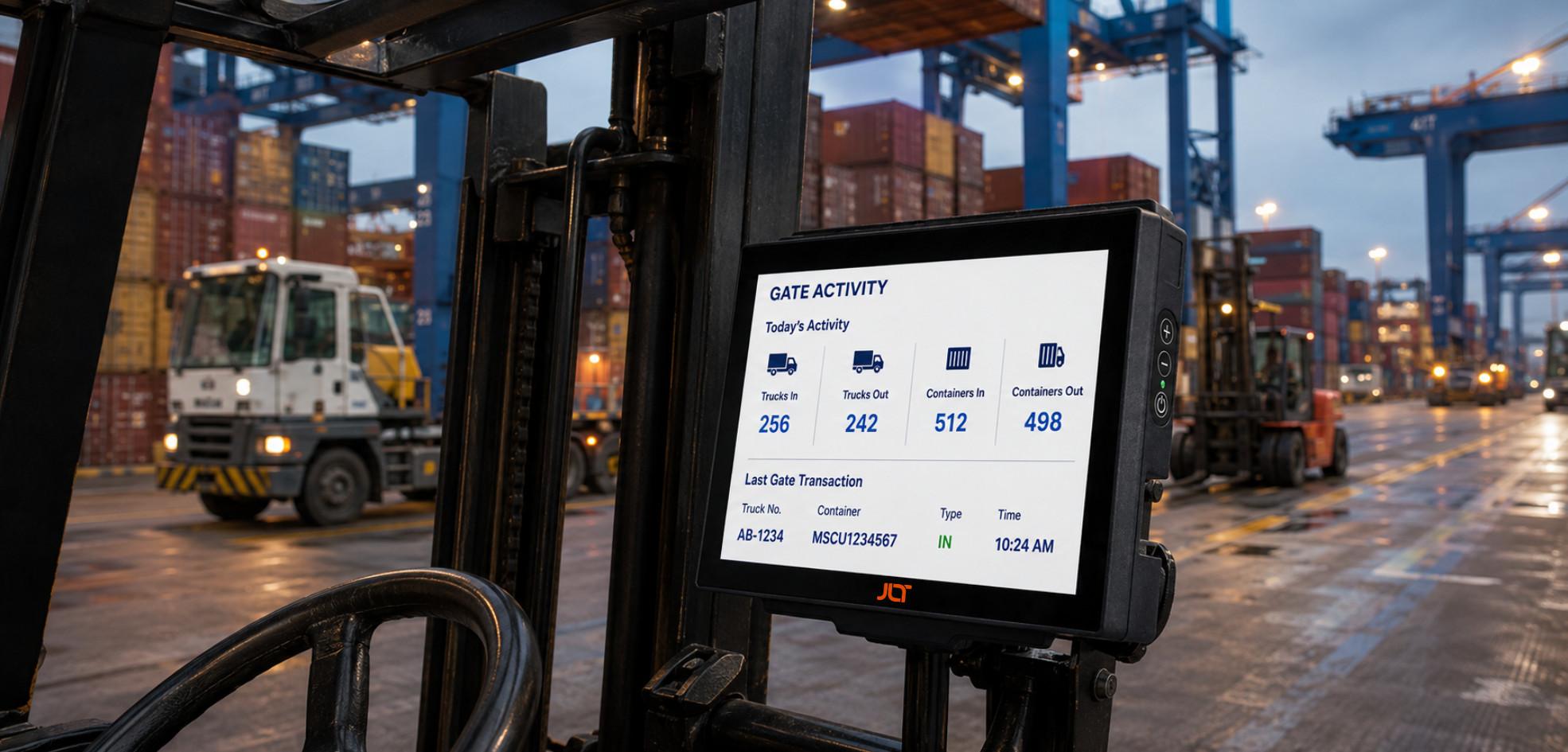
When a crane computer fails mid-lift at a container terminal, a reach stacker terminal loses connectivity during peak throughput, or a gate processing system goes down during vessel operations, the cost isn’t the device—it’s the stalled container movement, delayed vessel departure, cascading yard disruption, and TEU throughput loss that compounds with every minute down.
Container terminals are the hardest environment on earth for industrial computing hardware. Salt air corrosion, extreme vibration from heavy port equipment, direct outdoor sunlight, wide temperature swings, and 24/7 operational demands with zero tolerance for downtime—these are the conditions tough port computers are built specifically to handle. This guide covers everything terminal operators and port technology teams need to evaluate and select the right tough port computer—from TOS validation to construction standards that determine real-world service life.
What are tough port computers? (quick answer)
Purpose-built vehicle-mounted terminals engineered specifically for container terminal conditions—salt air, extreme vibration, outdoor sunlight, wide temperature ranges, and 24/7 duty cycles. Not standard rugged computers adapted for ports, but devices designed from the component level for port environments. The best combine corrosion-resistant construction, sunlight-readable displays up to 1,200 NITS, PowerTouch touchscreens, WiFi 6E plus WWAN, and Navis Ready TOS validation.
-
What makes a computer truly tough enough for port operations?
It must withstand salt air corrosion, survive crane and terminal tractor vibration, remain readable in direct outdoor sunlight, operate across full seasonal temperature ranges, and integrate cleanly with Navis N4 or Kaleris—without the integration risk generic rugged hardware creates. Standard rugged computers meet some of these demands; tough port computers meet all of them.
-
Why standard rugged computers are not enough for port environments?
Port environments are categorically more demanding than warehouses or manufacturing plants. Salt air corrodes hardware not designed for marine exposure. Crane vibration profiles exceed forklift specs. Outdoor sunlight exceeds 400 NITS display limits. And Navis N4 TOS integration requirements aren’t met by generic hardware—creating integration risk that terminals can’t afford.
What are tough port computers?
Understanding what separates a tough port computer from a standard industrial rugged device is the foundation of a procurement decision that holds up across a decade of terminal operations.
-
How are port computers defined?
An industrial device purpose-built for container terminal conditions—corrosion resistance for salt air, high shock and vibration ratings for heavy port equipment, sunlight-readable displays, wide-range power input for diverse port vehicle electrical systems, and TOS validation for Navis N4 and Kaleris.
-
What standards make a computer port-ready?
A combination of independently verified standards and port-specific certifications that go beyond the general industrial rugged specification.
-
Ip65/ip66 — salt air, water, and port exposure protection
IP65 protects against dust and low-pressure water jets; IP66 extends to powerful jets—the minimum for outdoor port environments where rain, spray, and washdown are routine and where IP66 sealing is the barrier between internal components and corrosive salt air.
-
Mil-std-810h — shock and vibration for heavy port equipment
MIL-STD-810H validates devices against the shock and vibration profiles of ship-to-shore cranes, RTG cranes, reach stackers, and terminal tractors—among the most demanding mechanical stress any industrial computing device faces.
-
Sunlight-readable displays — outdoor yard and crane visibility
Up to 1,200 NITS is the standard for tough port computers in outdoor environments. At 400 NITS — the maximum of most standard rugged computers—a display is unreadable in direct sunlight at any container terminal operating in daylight.
-
What is Navis n4 tos validation and why does it matter?
Navis Ready certification independently validates that a device integrates cleanly with Navis N4 — the most widely deployed TOS in container terminal operations worldwide. Without it, terminals face compatibility issues, system instability, and support gaps. JLT’s VERSO Series is the only VMT range in the world validated as Navis Ready for Kaleris N4 TOS integration.
Not sure which tough port computer fits your terminal?
Why port environments are the hardest test for industrial computers
The combination of corrosion, vibration, outdoor exposure, temperature extremes, and 24/7 demands creates a hardware stress profile standard industrial computers weren’t designed to survive.
-
What conditions in a container terminal destroy standard hardware?
Each condition individually shortens the standard hardware service life. Operating simultaneously and continuously, they destroy it.
-
Salt air corrosion — how it ends ordinary device lifecycles
Coastal terminals expose every piece of outdoor equipment to continuous salt air—accelerating corrosion of metal components, penetrating unsealed housings, and attacking PCBs and connectors. Standard hardware degrades within months; tough port computers use corrosion-resistant housing and sealing designed for years of coastal deployment.
-
Constant vibration in cranes, reach stackers, and terminal tractors
Ship-to-shore cranes, RTG cranes, reach stackers, and terminal tractors generate vibration profiles that exceed the design parameters of most standard rugged hardware — working connectors loose, fatiguing PCB solder joints, and causing premature failure in devices not engineered for heavy port equipment loads.
-
Extreme temperature swings between outdoor yards and enclosed equipment
From cold winter nights in northern European and North American ports to hot summer days in equatorial terminals, plus rapid thermal cycling between enclosed crane cabs and outdoor yards—tough port computers must run from -25°C to +55°C without throttling or failure.
-
24/7 operations — why port computers must never stop
Vessels arrive and depart around the clock, crane operations run through the night, and gate processing never stops. A port computer that requires reboots or fails under a sustained duty cycle load is not a viable terminal platform—regardless of other specifications.
-
What happens when a port computer fails mid-operation?
A crane computer failure during a lift halts the move. A reach stacker terminal failure stops yard operations. A gate processing failure during peak vessel operations creates queues that take hours to clear. Every failure has an immediate, measurable cost.
-
How downtime at a container terminal costs more than the device
At a terminal handling 500,000 TEU per year, every hour of crane downtime driven by computing failure carries TEU throughput loss, crane utilization reduction, vessel delay risk, idle labor costs, and cascading yard disruption—dwarfing the premium of purpose-built tough port computers over generic hardware.
Where are tough port computers used?
They’re deployed across every operational zone of a container terminal, each with specific hardware demands.
-
How are they used in crane operations and container handling?
They provide crane operators with real-time TOS data—container positions, move instructions, and stack plans—during continuous crane operation in outdoor environments with direct sunlight, salt air, and constant vibration. 1,200 NITS ensures readability; MIL-STD-810H validated construction survives crane vibration; Navis Ready validation ensures clean TOS integration.
-
How do they support yard equipment — straddle carriers and reach stackers?
Mounted in straddle carrier and reach stacker cabs, they provide real-time yard management data and container tracking on hardware that survives the demanding mechanical and environmental conditions of continuous heavy lifting and transport operations.
-
How are they used in gate operations and container processing?
They give gate clerks and processing systems reliable, fast TOS access on hardware that withstands outdoor exposure, temperature extremes, and the continuous duty cycle of 24/7 gate processing.
-
How do they support yard inspection and maintenance?
Inspection and maintenance teams access container condition records, equipment histories, and real-time TOS data across the full outdoor terminal yard—in conditions consumer and standard industrial hardware cannot survive.
-
How do they enable container tracking and inventory visibility?
WiFi 6E, WWAN, and Private LTE maintain continuous TOS connectivity across every operational zone — ensuring every container position, move, and status update reaches the TOS in real time without the connectivity gaps generic hardware creates in large outdoor port environments.
What defines the best tough port computer?
Construction, display, connectivity, and TOS integration together determine terminal uptime, crane utilization, and TEU throughput.
-
What construction is required for port-grade ruggedness?
Beyond the standard industrial rugged specifications—corrosion resistance for salt air, shock and vibration ratings for heavy port equipment, and wide-range power input for diverse port vehicle electrical systems.
-
Corrosion-resistant housing for salt air environments
Single-piece all-aluminium housing with salt air-resistant surface treatments eliminates the panel gaps in multi-piece assemblies where salt air penetrates and corrodes internal components.
-
High shock and vibration ratings for heavy port equipment
Board-to-board connectors replacing flex cables, PCBs fixed to the housing, and MIL-STD-810H validated architecture—design-stage decisions that address the vibration loads of heavy port equipment, not aftermarket additions.
-
Wide-range power input for compatibility with port vehicles
Accommodates the full range of port vehicle electrical systems—from 24V DC terminal tractors and reach stackers to higher-voltage crane systems—without additional power conditioning hardware.
-
What display capabilities are essential for port operations?
A display that can’t be read outdoors, misses gloved inputs, or dims in crane cab heat stops the operation at the point of failure.
-
Sunlight-readable high-brightness screens for outdoor yards
Up to 1,200 NITS — container positions, move instructions, and TOS data remain readable in direct outdoor sunlight across all daylight conditions in any geographic location.
-
Glove-friendly PowerTouch for port operators
Accurate touchscreen interaction with gloved, wet, and rain-soaked hands — the operational baseline for port equipment cabs in cold weather and rain.
-
What connectivity powers port terminal operations?
Every crane move, yard transfer, and gate transaction depends on continuous, reliable TOS data exchange. A connectivity failure during a crane move stops the move.
-
Wifi 6e for high-speed terminal data exchange
9.6 Gbps throughput ensures TOS data exchange completes without delays or dropped connections affecting crane cycle times and equipment utilization.
-
Wwan and private lte for outdoor port coverage
Extend connectivity across port yards, vessel berths, and gate complexes where WiFi coverage is inconsistent — ensuring continuous TOS connectivity regardless of equipment location.
-
5g — the future of port connectivity
Ultra-low latency, high bandwidth, and network slicing for port automation, remote crane operation, and autonomous terminal equipment. Tough port computers with 5G support are positioned for the next generation of terminal operations.
-
What tos integration does a tough port computer need?
Clean, validated TOS integration is the most critical operational requirement — and the area where the gap between purpose-built port computers and generic hardware is most significant.
-
Navis n4 tos validation — what it means for terminal operations
Navis Ready validation confirms clean, reliable Navis N4 integration — eliminating compatibility risk, ensuring correct TOS communication and system stability. JLT’s VERSO Series is the only VMT range in the world with this certification.
-
Kaleris integration — seamless terminal operating system support
The same clean, validated connectivity for terminals running the Kaleris terminal operating system — ensuring accurate TOS data access on hardware validated for the Kaleris platform.
Ready to evaluate tough port computers for your terminal?
Tough port computers: how does the JLT VERSO series compare?
JLT delivers purpose-built port computing through the VERSO Series—engineered specifically for container terminal operations and validated as Navis Ready for Kaleris N4 TOS integration.
-
What makes the VERSO series the choice for port environments?
Corrosion-resistant single-piece all-aluminium housing, Intel Core i3 and i7 1185GRE processors, displays up to 1,200 NITS, PowerTouch, WiFi 6E plus WWAN and Private LTE, wide-range power input, and Navis Ready Kaleris N4 TOS validation—backed by more than 30 years of in-house engineering and production in Sweden. The only VMT range in the world with Navis Ready validation.
-
How does the VERSO series perform in real port deployments?
OPCSA, the largest container terminal in the Canary Islands, standardized on JLT rugged computers—including VERSO Series devices—to future-proof terminal operations and maintain throughput across all crane and yard handling equipment.
-
How does JLT compare to generic rugged computers in port environments?
Generic rugged computers offer general industrial ruggedness—no Navis Ready validation, no salt-air-engineered corrosion resistance, no displays above 400 NITS, and no port-computing deployment experience. The gap is between a device that claims port suitability and one independently validated to deliver it.
How tough port computers improve teu throughput
The operational impact extends beyond device reliability—showing up in crane cycle times, equipment utilization, and overall TEU throughput.
-
How do they eliminate downtime that stalls container movement?
Hardware reliability, TOS integration stability, and operational continuity eliminate the computing downtime that stalls container movement—every minute of uptime a tough port computer delivers over a generic alternative translates directly into crane moves completed and TEU throughput achieved.
-
How do they improve crane and equipment utilization?
Across a fleet of 10–20 cranes operating 24/7, the utilization rate difference between purpose-built tough port computers and generic hardware is measurable in TEU throughput per operating hour—every reboot and connectivity loss avoided is a move completed.
-
How do they support port automation and digital transformation?
WiFi 6E, Private LTE, and 5G provide the communication infrastructure port automation depends on—positioning terminals to scale automated stacking cranes, remote crane operation, and autonomous equipment on hardware built for the next generation of terminal technology.
How JLT delivers tough port computers for terminals worldwide
With more than 30 years of in-house engineering and production in Sweden, JLT delivers tough port computers through the VERSO Series—backed by a full ecosystem of software, services, and support.
-
How the VERSO series is engineered specifically for port environments
Every engineering decision is made for the port environment—corrosion-resistant housing, high shock and vibration ratings, 1,200 NITS displays, wide-range power input, and Navis Ready Kaleris N4 TOS validation. Not features added to a general industrial platform — the design foundation of a port-specific computing platform.
-
How jlt’s Navis ready validation reduces integration risk
Validated integration means clean TOS communication, stable system performance, and manufacturer support for Navis N4 deployments — reducing project risk and operational instability that unvalidated hardware creates.
-
How JLT insights provides fleet visibility across terminal equipment
Real-time fleet visibility — remote diagnostics, usage analytics, maintenance alerts, impact monitoring, and device health tracking — gives terminal technology teams visibility to identify issues before they become operational failures.
-
How JLT care guarantees uptime in 24/7 port operations
A no-questions-asked agreement covering all VERSO Series failures with guaranteed repair turnaround, worldwide pick-up and drop-off, and fixed-price coverage in 3-year and 5-year terms.
-
How JLT customization solves port-specific hardware requirements
More than 100 customizations over 30 years — custom antenna configurations, CAN-bus integration, ATEX adaptations, private labeling, and fully custom hardware for specific crane and equipment mounting configurations.
Ready to find the right tough port computer for your terminal?
Frequently asked questions
What is the difference between a tough port computer and a standard rugged computer?
What is Navis Ready validation and why does it matter for terminal operators?
What connectivity do tough port computers need for terminal operations?
What display brightness do port computers need for outdoor yard operations?
How do tough port computers handle the vibration of crane operations?
How long do JLT tough port computers last in terminal environments?
Still have questions?