
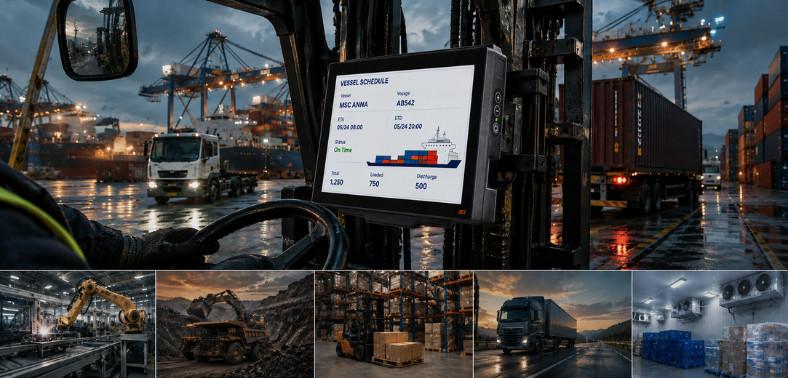
When an industrial operation deploys the wrong computing hardware—a consumer tablet in a cold storage facility, a standard laptop in a crane cab, or a generic device on a manufacturing floor—the failure is not a surprise. It is the predictable outcome of deploying technology never designed for the environment it is operating in.
Rugged technology exists because industrial environments destroy standard hardware. It is the category of computing devices, software platforms, and service ecosystems purpose-built for the conditions that consumer and commercial technology cannot survive—extreme temperatures, constant vibration, dust, moisture, salt air, and 24/7 operational demands. This guide covers everything industrial operations need to know about rugged technology — from the standards that define genuine ruggedness to the hardware categories, deployment environments, connectivity standards, software ecosystems, and trends shaping the future of industrial computing worldwide.
What Is Rugged Technology? (Quick Answer)
Rugged technology is the category of computing hardware, software, and services purpose-built for industrial environments—designed to operate reliably where consumer and commercial technology fails. It encompasses vehicle-mounted terminals, rugged tablets, rugged field devices, and the software and service ecosystems that extend their value across a full operational lifecycle. For industrial operations, rugged technology delivers the hardware reliability, software integration, and service continuity that modern industrial workflows depend on — from ports and manufacturing plants to cold storage facilities, mining operations, and transportation fleets operating 24/7.
-
How Is Rugged Technology Defined in Industrial Contexts?
In industrial contexts, rugged technology is defined by independently verified standards—IP ingress protection ratings, MIL-STD-810H environmental testing, ATEX compliance for hazardous environments, and operating temperature ranges covering the full spectrum of industrial deployment. A device is genuinely rugged when independently validated to perform in its conditions—not when it carries a rugged label applied by a marketing team.
-
What Separates Rugged Technology from Consumer-Grade Devices?
The separation is categorical, not incremental. Consumer devices are designed for controlled environments and two-year replacement cycles. Rugged technology is designed for industrial environments, five- to ten-year service lives, and the specific physical and environmental stresses industrial operations produce every shift.
What Is Rugged Technology?
Understanding the engineering principles, standards, and hardware categories that define rugged technology is the foundation of any industrial computing procurement decision.
-
How Are Rugged Devices Engineered Differently from Standard Hardware?
At the component level — not the case level. Single-piece all-aluminium housings, board-to-board connectors replacing flex cables, PCBs fixed directly to the housing, and PowerTouch displays that respond to gloved and wet hands are design-stage decisions that cannot be retrofitted to a consumer device.
-
What Standards and Certifications Define Rugged Technology?
Internationally recognized, independently verified benchmarks that separate genuine industrial ruggedness from marketing claims—any evaluation that skips these certifications is evaluating the wrong thing.
-
IP Ratings — Dust and Water Protection Explained
IP54 is insufficient for most industrial environments. IP65 provides full dust protection and low-pressure water jet resistance. IP66 extends to powerful water jets—required for washdown in food and beverage, cold storage, and outdoor operations. IP67 adds temporary immersion. IP65 is the minimum; IP66 is recommended for regular moisture exposure.
-
MIL-STD-810H — Shock, Vibration, and Environmental Testing
The US military standard validates devices against shock, vibration, humidity, altitude, and temperature extremes under controlled conditions—independently verified performance, not claims. The most rigorous environmental testing standard applicable to industrial computing hardware.
-
ATEX Compliance — Rugged Technology for Hazardous Environments
ATEX certification covers equipment deployed in potentially explosive atmospheres—chemical plants, oil and gas, and mining—where flammable gases, dusts, or vapors may be present. A safety-critical requirement that standard rugged technology does not address.
-
Operating Temperature Range — The Industrial Benchmark
Consumer devices manage 0–35°C. Industrial rugged technology runs from -30°C to +55°C—covering blast freezers, cold storage, outdoor port yards, and factory floors. Automatic screen heaters and thermal management systems are standard features.
-
What Are the Main Categories of Rugged Technology?
Three primary hardware categories, each designed for a specific deployment model and operational role.
-
Vehicle-Mounted Terminals — The Backbone of Industrial Operations
Permanently mounted to vehicles—forklifts, reach trucks, cranes, and haul trucks—powered by the vehicle’s electrical system and engineered for continuous vibration, shock, and environmental exposure across extended duty cycles. The backbone of warehouse, manufacturing, port, mining, and agricultural computing fleets worldwide.
-
Rugged Tablets — Mobile Computing for Field and Floor
Portable devices carried by inspectors, maintenance engineers, supervisors, and field operators — combining tablet mobility with industrial construction standards, display technology, and connectivity that consumer tablets cannot match in environments that destroy them within months.
-
Rugged Custom Solutions — When Off-the-Shelf Is Not Enough
Purpose-built hardware for operations with specific requirements standard products can’t meet—custom antenna designs, ATEX compliance, CAN-bus integration, private-label hardware, or specific vehicle mounting configurations.
Why Industrial Operations Depend on Rugged Technology
The dependence on rugged technology is not a technology preference — it is an operational requirement. Standard hardware fails in industrial environments, and the consequences make rugged technology not a cost but an investment that delivers positive returns across a five- to ten-year horizon.
-
What Happens When Standard Technology Fails in Industrial Environments?
A VMT failure stops the forklift operator’s workflow. A tablet failure on a manufacturing floor stops the quality inspection. A computing failure in a crane cab stops the crane. The cost is measured in operational downtime, lost throughput, idle labor, and cascading disruption—not in device replacement cost.
-
How Does the Wrong Technology Choice Affect Total Cost of Ownership?
Consumer hardware in industrial environments generates frequent replacement cycles, IT overhead, productivity losses, and retraining costs. Every one of these costs is eliminated or significantly reduced by deploying genuinely rugged technology that survives its operating environment—consistently delivering lower TCO over three to five years.
-
Why Rugged Technology Delivers Better ROI Over Three to Five Years
A rugged VMT with a 3-year standard warranty and decade-long service life delivers measurably lower total cost per operational hour than a consumer device replaced every 18 months. The ROI calculation is the difference between hardware that compounds value and hardware that compounds cost.
See how JLT rugged technology reduces downtime in your operation.
Where Is Rugged Technology Used?
Deployed across the most demanding industrial environments worldwide — each creating specific hardware demands that purpose-built rugged technology is engineered to meet reliably.
-
How Does Rugged Technology Power Port and Container Terminal Operations?
It powers crane operations, yard equipment, gate processing, and inspection teams—across outdoor environments with salt air, extreme vibration, direct sunlight, and 24/7 demands. JLT’s VERSO Series — the only VMT range validated as Navis Ready for Kaleris N4 TOS integration — is purpose-built for container terminal operations worldwide.
-
How Is It Used in Manufacturing and Factory Automation?
It connects operators to MES systems, supports lineside replenishment, enables digital quality inspections, and provides production traceability across floors where vibration, dust, and continuous duty cycles destroy consumer hardware. SSAB has run JLT rugged computers since 2003 with an almost non-existent failure rate.
-
How Does It Support Cold Storage and Temperature-Controlled Logistics?
Temperature transitions between -30°C freezer zones and ambient areas create condensation that destroys unsealed hardware. Rugged technology built for cold storage operates at -30°C with automatic screen heaters, IP66 sealing, and PowerTouch displays for gloved hands in freezer conditions.
-
How Does It Enable Warehousing and Distribution Operations?
It gives operators real-time WMS access on VMTs and portable tablets that survive the drops, vibration, and temperature swings of warehouse operations. Solar Denmark deployed JLT VMTs with SAP EWM — improving throughput and on-time delivery across five countries and more than 3,000 employees.
-
How Is Rugged Technology Used in Mining and Heavy Industry?
It provides real-time ore quality data, predictive maintenance alerts, and fleet management on hardware mounted in haul trucks, drilling equipment, and mining vehicles—across environments with extreme dust, vibration, and temperature ranges that exceed standard industrial hardware parameters.
-
How Does It Support Transportation, Logistics, and Yard Management?
It gives drivers, dispatchers, and yard supervisors mobile access to routing, delivery confirmation, compliance documentation, and real-time fleet visibility—across outdoor environments where connectivity, display readability, and device durability determine whether the mobile workflow functions or fails.
-
How Is Rugged Technology Used in Agriculture and Forestry?
It provides machine operators and field managers with real-time data on planting, harvesting, and forestry operations—across outdoor environments with dust, vibration, temperature extremes, and moisture that consumer hardware cannot survive. JLT’s 30+ years of engineering include agricultural and forestry deployments.
-
How Does It Support Defense and Mission-Critical Operations?
It provides computing capability for vehicle-mounted command and control, logistics management, and field operations—on hardware engineered to military standards for shock, vibration, temperature, and electromagnetic compatibility.
Key Features That Define the Best Rugged Technology
Construction, display, connectivity, and software ecosystem together determine whether a device performs reliably across a five- to ten-year service life.
-
What Construction Standards Separate Rugged from Truly Rugged?
Made at the design stage — not added through protective cases or aftermarket modifications.
-
Single-Piece All-Aluminium Housing — Swedish Engineering Explained
Milled from a single block of aluminium for superior sealing, heat dissipation, and structural integrity—eliminating the panel gaps and assembly joints where dust, moisture, and corrosion enter and end device service life in multi-piece assemblies.
-
Board-to-Board Connectors and No Flex Cables
Replacing flex cables entirely eliminates the internal connections that work loose under constant vibration in forklift, crane, and haul truck environments—removing a primary failure mode that consumer and standard industrial hardware cannot avoid.
-
PCB Fixed to Housing — Shock and Vibration Resistance
Fixing the PCB directly to the housing eliminates movement between the board and housing under shock and vibration—preventing fatigue failures at PCB solder joints that continuous vibration causes in devices where the PCB floats on mounts.
-
What Display Technology Does Industrial Rugged Equipment Need?
A display that fails in sunlight, misses gloved inputs, or frosts in cold storage creates operational friction that compounds across every transaction on every shift.
-
Up to 1,200 NITS — Industrial Brightness Standard
At 1,200 NITS, the display remains clearly readable in direct outdoor sunlight. At 400 NITS — the maximum of most standard rugged computers—it is unreadable in the outdoor sunlight conditions common to port yards, agricultural operations, and transportation hubs.
-
PowerTouch — Glove and Wet-Hand Operation
Accurate touchscreen interaction with gloved, wet, and rain-soaked hands — without missed inputs or hesitation. The operational baseline for cold storage, food and beverage, port operations, and manufacturing, where gloves are standard PPE.
-
Screen Heater Options for Cold Storage and Freezer Environments
Automatic screen heaters activate before frost forms, maintaining display readability and touchscreen responsiveness in blast freezer conditions where consumer and standard industrial displays fail within minutes.
-
What Connectivity Powers Modern Rugged Technology?
The link between rugged technology and every system it accesses — WMS, MES, ERP, TOS, and enterprise mobility management platforms.
-
WiFi 6E (9.6 Gbps) — The New Industrial Wireless Standard
9.6 Gbps throughput eliminates dead zones, dropped connections, and bandwidth limitations — providing the bandwidth, reliability, and low latency that modern WMS, MES, and ERP integrations require in high-density industrial environments.
-
WWAN and Private LTE for Coverage Beyond Four Walls
Extend connectivity beyond WiFi infrastructure to outdoor yards, port terminals, mining sites, and large campuses — keeping rugged technology connected across the full operational footprint for operations spanning indoor and outdoor environments.
-
5G — The Future of Industrial Connectivity
Ultra-low latency, high bandwidth, and network slicing for industrial automation, remote equipment operation, and real-time fleet management. Rugged technology with 5G support is positioned for the connectivity infrastructure that the next generation of industrial operations will be built on.
-
What Software Ecosystem Extends Rugged Technology Value?
Fleet visibility, safety functionality, and long-lifecycle OS support extend operational value beyond the hardware itself.
-
JLT Insights — Fleet Visibility and Operational Analytics
Real-time fleet visibility—remote diagnostics, usage analytics, proactive maintenance alerts, impact monitoring, and battery health tracking—turns rugged hardware into an active source of operational intelligence that identifies issues before they become failures.
-
JLT Forkbeard — Proximity Detection and Safety
A Bluetooth-based proximity detection and forklift safety solution that alerts pedestrians and operators when they enter each other’s proximity zones — reducing pedestrian-forklift incident risk without requiring separate safety hardware infrastructure.
-
Industrial Android x86 and Windows 11 IoT LTSC
Industrial Android x86 for modern touchscreen-first workflows and enterprise mobility management; Windows 11 IoT LTSC for enterprises running WMS and ERP on Windows infrastructure with long-term lifecycle requirements. Both supported across the JLT range.
Want to see these features in action?
Rugged Technology Trends Shaping Industrial Operations
The rugged technology landscape is evolving rapidly — driven by connectivity, AI, edge computing, and the digital transformation of industrial operations worldwide.
-
How Is Private 5G and WiFi 6E Changing Industrial Connectivity?
Devices with legacy WiFi connectivity will become connectivity bottlenecks as 5G and WiFi 6E infrastructure become standard—making both a procurement requirement for any rugged technology investment intended to support the next five to ten years of industrial operations.
-
How Is AI-Powered Screen Blanking Improving Operator Safety?
Camera-based detection identifies when a vehicle is in motion and automatically blanks the display—preventing operators from using the computing interface while driving and reducing distraction-related incidents in industrial vehicle environments.
-
How Is Edge Computing Extending the Role of Rugged Technology?
Edge computing brings data processing to the point of operation — enabling real-time decisions at the machine level without round-trip latency to central infrastructure. For automated stacking cranes, predictive maintenance, and autonomous vehicle guidance, edge capability in rugged hardware is becoming a standard requirement.
-
How Is Industry 4.0 Driving Demand for Smarter Rugged Devices?
Connected rugged devices that feed real-time data to MES platforms, provide predictive maintenance signals, and integrate with industrial IoT infrastructure are the rugged technology products that Industry 4.0 operations are specifying the best rugged technology manufacturers are delivering.
How to Choose the Right Rugged Technology for Your Operation
A structured evaluation across five steps — going beyond hardware specifications to consider environment, workflow, TCO, and vendor support lifecycle.
-
Step 1 — Map Your Operating Environment and Conditions
Start with the operating environment—temperature range, dust and moisture exposure, indoor versus outdoor, vehicle type, and specific hazards like salt air or explosive atmospheres. The environment determines the minimum IP rating, temperature range, and certifications required — and eliminates devices not engineered for the specific deployment conditions.
-
Step 2 — Define Your Workflow and Software Requirements
Define the workflow — WMS, MES, ERP, TOS, inspection, maintenance, or field service — and the OS platform those applications require. Windows 11 IoT LTSC for Windows-native applications; Industrial Android x86 for modern touchscreen-first workflows.
-
Step 3 — Evaluate Total Cost of Ownership Not Just Unit Price
Evaluate TCO across three to five years — include replacement costs, IT overhead, downtime productivity losses, retraining, and warranty coverage. A rugged device with a 3-year warranty consistently delivers lower TCO than a consumer device replaced every 18 months in the same industrial environment.
-
Step 4 — Assess Vendor Support Lifecycle and Service Agreements
A five- to ten-year device service life requires a vendor that supports the device across that lifecycle. JLT Care service agreements — in 3-year and 5-year terms — provide predictable, fixed-price coverage that gives operations certainty of device support across the full deployment horizon.
-
Step 5 — Pilot Before You Scale
Pilot the selected technology in the actual operating environment before scaling. A controlled pilot validates hardware performance, OS compatibility, connectivity reliability, and mounting configuration in real conditions—confirming operational performance before full fleet rollout.
How JLT Delivers Rugged Technology for the World’s Most Demanding Operations
With more than 30 years of in-house engineering and production in Sweden, JLT delivers rugged technology across VMTs, rugged tablets, and custom solutions—backed by a full ecosystem of software, services, and support.
-
How 30+ Years of Engineering Backs Every JLT Rugged Solution
More than 30 years across ports, mining, cold storage, manufacturing, agriculture, and defense is built into every construction decision, component choice, and testing standard before a device leaves Växjö, Sweden.
-
How JLT’s In-House R&D and Swedish Production Ensures Quality
JLT designs, develops, and manufactures every product in-house in Sweden—full control over quality, component availability, and product lifecycle at every stage. Engineering decisions made for the industrial deployment environment, not consumer market preferences.
-
How JLT Customization Delivers Solutions Standard Products Cannot
More than 100 customizations over 30 years — custom antennas, CAN-bus integration, ATEX adaptations, private labeling, specialized connectors, and fully custom hardware for any vehicle type, mounting configuration, or operating environment.
-
How JLT Care and JLT Insights Extend the Value of Every Device
JLT Care provides predictable, fixed-price coverage for all device failures across 3-year and 5-year terms. JLT Insights provides real-time fleet visibility—turning rugged hardware into operational intelligence that extends service life and reduces unplanned downtime.
-
How JLT Partners with Ivanti, SOTI, and Navis to Deliver Complete Solutions
Ivanti and SOTI for enterprise mobility management across Windows and Android fleets. Navis Ready validation for clean Navis N4 TOS integration in container terminal deployments — eliminating the integration risk generic hardware creates in port computing environments.
Ready to find the right rugged technology for your operation?
Frequently Asked Questions
What is the difference between rugged technology and standard commercial hardware?
What IP rating do I need for industrial rugged technology?
What is the difference between Windows 11 IoT LTSC and Industrial Android x86?
How does JLT Insights support rugged technology fleet management?
What is the service life of JLT rugged technology in industrial environments?
How do I choose between a VMT and a rugged tablet for my operation?
Still have questions?