
Industrial vehicles operate in some of the most challenging environments—warehouses, ports, airports, mining sites, construction zones, and manufacturing facilities. These settings expose equipment to vibration, dust, moisture, temperature extremes, and constant movement. To maintain productivity and safety, organisations rely on rugged IT solutions designed for demanding mobile operations.
For airports and aviation operations, GSE ground support equipment plays a critical role in keeping aircraft turnaround activities moving. From baggage and cargo handling to ground servicing and maintenance, operators need reliable access to digital workflows while working around aircraft and heavy equipment.
Unlike standard consumer electronics, rugged IT solutions are purpose-built to withstand harsh conditions while delivering continuous access to operational data. Whether installed on forklifts, loaders, baggage vehicles, terminal tractors, or heavy-duty trucks, rugged systems provide dependable performance where downtime is not an option.
Rugged it for gse ground support equipment: what makes it essential?
Ground operations depend on equipment and personnel working together efficiently. GSE supports a wide range of airport activities, and the technology installed on these vehicles needs to remain available throughout demanding shifts.
Rugged in-vehicle computers help ensure that:
- Critical data is accessible directly from the vehicle
- Systems remain operational during long shifts
- Devices withstand shock and vibration
- Connectivity remains stable across facilities and outdoor areas
- Operators can work safely without unnecessary distraction
When computing hardware is designed around the vehicle and workflow, operators can access instructions, work orders, inspection information, inventory data, and communication tools without relying on fragile consumer devices.
Purpose-built computing also allows organisations to standardise technology across different vehicle types and operational areas. Instead of using equipment designed primarily for offices or consumer environments, businesses can select platforms specifically engineered for mobile industrial applications.
Designed to withstand harsh operating conditions
Industrial and airport environments are unforgiving. Constant vibration from vehicle movement, exposure to airborne dust, contact with moisture, and temperature fluctuations can quickly affect conventional hardware.
Rugged IT systems are engineered to handle:
- Continuous vibration and impact
- Dust and water exposure
- Wide temperature ranges
- Long operational hours
- Permanent vehicle mounting
Sealed enclosures, reinforced connectors, solid-state storage, and high-brightness displays can help maintain consistent performance. These design features reduce the risk of hardware failure and support longer product lifecycles in demanding environments.
For GSE ground support equipment operating outdoors or around aircraft, environmental protection is particularly important. Vehicles may move between indoor and outdoor areas, encounter changing weather conditions, and experience repeated vibration throughout each shift.
A rugged computer should therefore be selected based on the actual operating conditions rather than simply its appearance or general-purpose specifications. Factors such as temperature tolerance, ingress protection, vibration resistance, mounting requirements, and display visibility all contribute to long-term reliability.
Improving operational efficiency and visibility
Modern operations depend on real-time visibility. Rugged IT solutions enable integration with warehouse management systems, fleet management platforms, enterprise applications, maintenance systems, and other operational software.
With rugged in-vehicle systems, organisations can:
- Digitise inspections and safety checklists
- Track inventory and material movement in real time
- Coordinate tasks between operators and supervisors
- Capture operational data accurately
- Reduce paperwork and manual errors
For airport operations, these capabilities can help connect vehicle operators with dispatch teams and back-office systems. Instead of recording information manually and entering it later, workers can capture and access data at the point of operation.
This approach can be especially valuable when GSE is used across large airport environments where vehicles and personnel need to coordinate continuously.
Real-time access to information can also help supervisors identify bottlenecks, allocate resources, and respond to changing operational requirements. When information flows directly between vehicles and central systems, organisations gain greater visibility into work progress and equipment activity.
Supporting safety and compliance
Safety is a priority in any industrial environment. Airports add another layer of complexity because ground vehicles operate close to aircraft, personnel, baggage, cargo, and other equipment.
Rugged IT supports safety initiatives by:
- Enabling operator authentication
- Providing digital inspection forms
- Delivering safety alerts and task instructions
- Recording compliance data for audits
- Giving operators access to relevant information without unnecessary movement
Reliable, permanently mounted systems help keep safety-critical information accessible during demanding shifts. They can also support more consistent documentation by replacing paper-based processes with digital records.
Digital inspections can make it easier to document vehicle conditions before and after use, identify issues, and maintain records for internal processes or compliance requirements. Providing information directly on the vehicle can also reduce the need for operators to move between equipment and fixed workstations.
For organisations managing fleets of GSE ground support equipment, consistent access to inspection and operational information can support safer, more structured workflows.
Reducing downtime and total cost of ownership
IT failures can disrupt entire operations. When a device fails, repairs and replacements can create additional costs, while the loss of access to operational applications can slow the wider workflow.
Rugged IT solutions are designed for long service lifecycles, reducing the need for frequent replacements. Their durability and reliability can contribute to:
- Fewer disruptions
- Lower maintenance costs
- Extended hardware lifespan
- Improved fleet uptime
- More predictable technology costs
For organisations managing ground-support fleets, these benefits can be particularly important because vehicle availability directly affects ground operations and turnaround activities.
When evaluating total cost of ownership, businesses should consider more than the initial purchase price. Hardware durability, maintenance requirements, replacement cycles, deployment effort, support services, and operational downtime can all influence the long-term value of an IT investment.
A consumer device may have a lower upfront price, but frequent replacement, damage, downtime, and additional accessories can increase its overall cost. Purpose-built rugged hardware is designed to remain productive in environments where standard devices may require more frequent intervention.
Scalable solutions for evolving industrial operations
Industrial and aviation operations continue to modernise through automation, digitalisation, connected equipment, and real-time data integration. Rugged IT provides a scalable foundation for these initiatives.
Whether deployed across a small facility, distribution centre, manufacturing site, or large airport, rugged in-vehicle systems can scale to meet growing operational demands while maintaining consistent performance standards.
The right solution can also support different vehicle types and workflows across an organisation. A common rugged computing strategy can simplify fleet management while allowing individual deployments to address specific power, mounting, display, connectivity, and application requirements.
As organisations add more connected equipment and digital workflows, the ability to deploy consistent computing platforms across multiple locations can become increasingly important. Standardised hardware can simplify deployment, support, maintenance, and lifecycle management.
The future of industrial vehicle computing
As industries place greater emphasis on efficiency, safety, and data-driven decision-making, dependable vehicle-mounted technology becomes increasingly important.
Connected devices can help organisations collect operational data, monitor equipment, and identify opportunities for process improvement. Edge computing can support applications that require rapid access to information, while cloud-based platforms can connect field operations with enterprise systems.
For airport operations, these developments may create new opportunities to improve how GSE ground support equipment is monitored, dispatched, maintained, and integrated with wider operational workflows.
Purpose-built computing platforms provide the physical foundation for these digital initiatives. By combining rugged hardware with reliable connectivity and appropriate software, organisations can build technology environments that remain useful as their operational requirements evolve.
Future deployments may also incorporate more advanced analytics, artificial intelligence, predictive maintenance, and connected fleet-management capabilities. These technologies can help organisations move from simply collecting operational data to using it to make faster and more informed decisions.
Why JLT mobile computers fits mission-critical vehicle operations
JLT Mobile Computers develops rugged computing systems for demanding industrial environments. Rather than adapting consumer hardware to difficult conditions, JLT focuses on purpose-built platforms designed around vehicle-based workflows.
This approach considers factors such as mounting, power, display usability, connectivity, environmental protection, and long-term support. The result is a computing platform designed to remain dependable where standard devices may struggle.
For organisations operating forklifts, terminal tractors, heavy-duty vehicles, and other industrial equipment, the right rugged computer can support productivity while helping reduce disruptions caused by unsuitable hardware.
JLT’s vehicle-mount computing approach is built around the practical requirements of industrial operations. Compact form factors, rugged construction, flexible connectivity, vehicle integration, and lifecycle support can help organisations deploy technology that remains useful over years of operational use.
JLT vehicle-mounting solutions
JLT offers rugged computing platforms designed for demanding vehicle-based operations.
Jlt6015 – 15.6-inch rugged computer
The JLT6015 combines a 15.6-inch Full HD display with a rugged platform designed for demanding industrial applications. It supports Windows 11 IoT Enterprise LTSC and optional 5G connectivity, with a sunlight-readable, glove-operable display.
Its larger display can provide operators with clear access to information and applications while maintaining the rugged characteristics required for vehicle-based industrial workflows.
Jlt6012a – 12-inch rugged computer
The JLT6012A is a compact 12-inch platform designed for demanding vehicle applications. It runs Android 12 with GMS and supports a 9–72 VDC power range. An optional keyboard and JLT Insights capabilities provide additional flexibility for industrial workflows.
Its compact form factor can be useful where available space inside a vehicle cab is limited while still requiring a larger interface than a handheld device.
JLT6012 – 12-inch rugged computer
The JLT6012 combines a compact form factor with Windows 10/11 IoT LTSC support. Its capacitive touch interface, including JLT PowerTouch technology, is designed for industrial use, while WWAN 4G/5G and Wi-Fi 6E provide flexible connectivity options.
The platform provides a balance of size, connectivity, and computing capability for demanding vehicle-mounted applications.
VERSO series
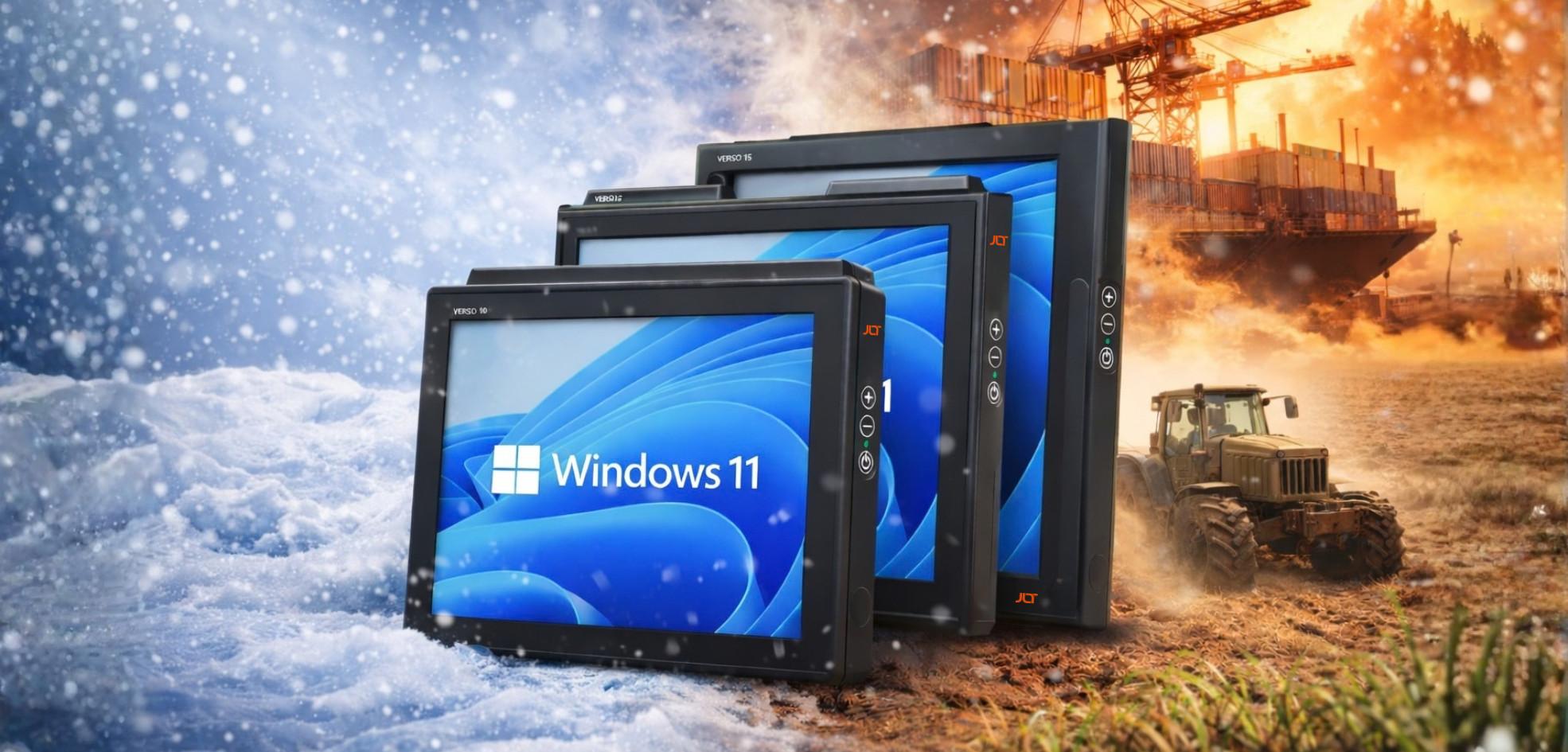
The VERSO series is available in 10-, 12-, and 15-inch configurations. These ultra-rugged, dock-free computers use Intel Core i3/i7 processors and provide sunlight-readable displays. For port operations, VERSO platforms are also Navis Ready.
The range gives organisations flexibility when selecting a display size and computing configuration for specific vehicles and operational workflows.