
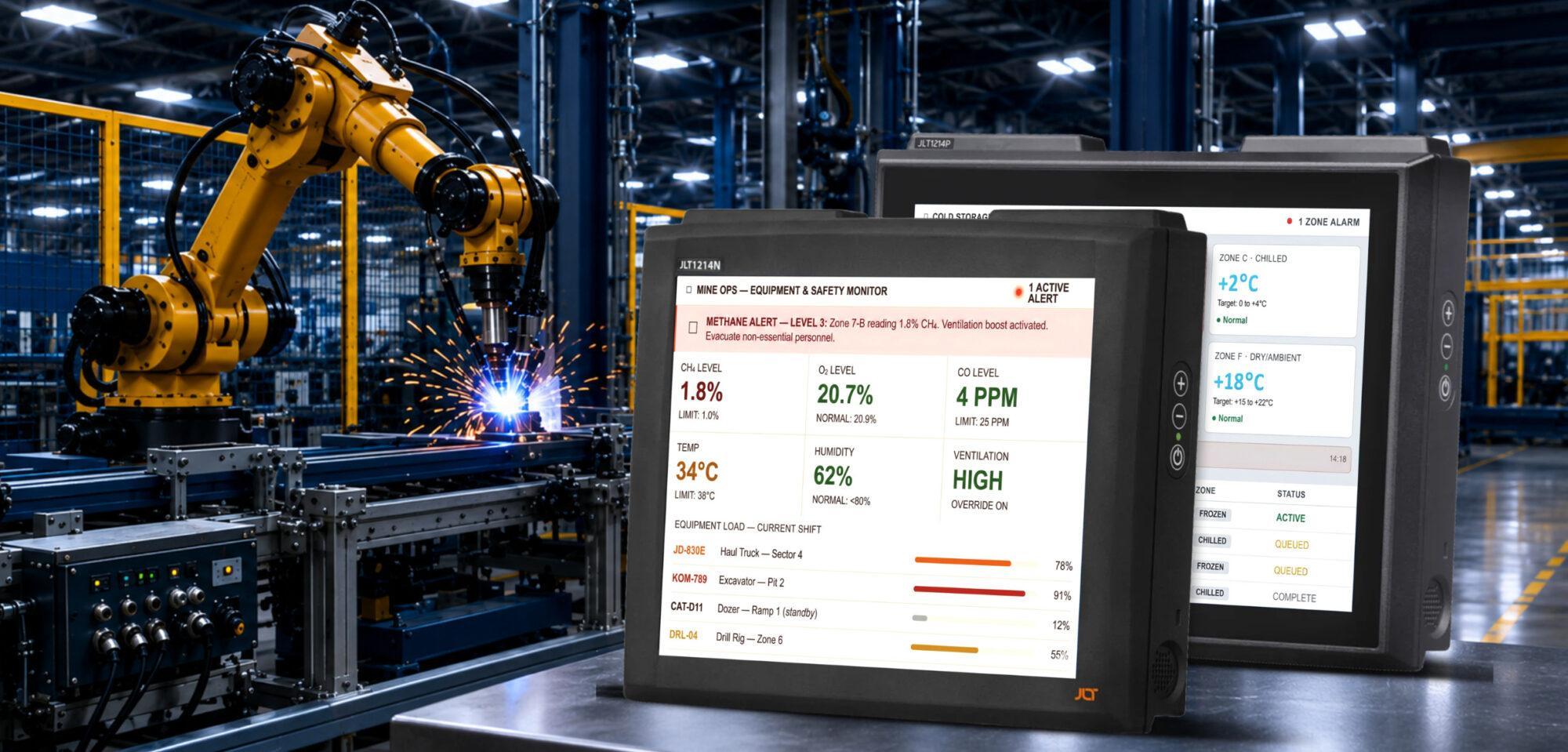
Industrial automation has fundamentally changed where computing hardware operates. Machines no longer work in isolation; instead, they communicate, respond, and adjust in real time. The infrastructure enabling this shift is not in a server room; it is on the factory floor, in port terminals, on heavy vehicles, and embedded in equipment running around the clock. Reliability here depends entirely on hardware built for the conditions. Standard commercial computers are not that hardware. Rugged computers are.
What Smart Manufacturing Actually Demands From Factory Floor Hardware
Modern industrial automation is not machines replacing manual tasks; it is machines, software, and data infrastructure operating as one connected system. Smart manufacturing facilities run adaptive, data-driven processes where IIoT sensors feed real-time data to control systems; those systems adjust equipment dynamically, and every action is logged within milliseconds.
This has moved computing hardware from the control room into the operational environment — distributed at the machine, on the vehicle, and at the process edge. Rugged computers provide the infrastructure layer that enables computing resources to operate reliably at the point where Operational Technology and Information Technology intersect.
Why the Factory Floor Is Hostile Territory for Standard Hardware
Industrial environments impose physical and electromagnetic stresses that commercial computers are never designed for. Four specific conditions account for the majority of hardware failures in automated operations.
The Conditions That Eliminate Standard Hardware
Temperature extremes across furnace lines, cold storage zones, and outdoor yards push hardware beyond commercial tolerances, accelerating failure through thermal stress and condensation.
Vibration and mechanical shock from forklifts, presses, and conveyor systems gradually degrade connectors, storage media, and internal circuitry.
Dust, liquids, and chemical exposure in machining, food processing wash-down, and chemical facilities introduce ingress risk through the ventilation openings that standard computers depend on. In these environments, sealed and fanless design is a baseline requirement rather than an optional enhancement.
Electromagnetic interference from welding, variable frequency drives, and high-current motors corrupts data and triggers crashes. Silent data corruption is the most operationally dangerous failure mode in automated workflows.
What a Hardware Failure Does to a Live Automated Line
A failed node in a connected workflow does not affect only one function. A failed HMI removes operator process visibility; a failed edge computer drops its sensor feed, creating a monitoring blind spot. In tightly sequenced processes, one failure causes dependent systems to stop or operate on incomplete data — neither acceptable in a live production environment. Recovery means taking the system offline to diagnose, replace, and reconfigure the device, making hardware selection a business continuity decision.
What Makes a Computer Truly Rugged: Standards, Certifications, and Form Factors
“Rugged” gets applied broadly across hardware marketing. The difference between genuine ruggedization and reinforced aesthetics lies in testable, verifiable standards and in physical design choices that reflect the actual deployment environment.
MIL-STD-810, IP Ratings, and ATEX: What the Standards Actually Verify
MIL-STD-810H is a test protocol rather than a marketing label because it subjects devices to temperature shock, vibration, mechanical shock, humidity, and dust exposure under controlled conditions, providing a verifiable basis for environmental claims.
IP ratings define ingress protection, from dust exclusion to resistance against high-pressure wash-down conditions.
ATEX and IECEx certifications are required where flammable gases or combustible dusts create explosion risk, such as in mining, certain processing facilities, and fuel-handling environments. Deploying uncertified hardware in these zones is a regulatory violation, not just an operational risk.
Form Factors: Matching the Device to the Deployment
Panel PCs and HMI terminals are fixed-mount, operator-facing devices at machine control stations, requiring sustained display uptime, brightness for variable industrial lighting, and gloved-touch capability. Vehicle-mounted computers on forklifts and heavy vehicles prioritise vibration tolerance, powered cradle integration, and seamless connectivity across large operational footprints. Fanless box PCs and embedded industrial computers integrate directly into machinery with no moving parts, designed for uninterrupted 24/7 operation as edge processors and OT/IT gateway nodes.
Not sure which form factor fits your operation?
The Functional Roles of Rugged Computers in Industrial Automation
Rugged computers perform distinct, defined operational functions within automated workflows. Each function below represents a specific job that hardware on the factory floor, vehicle fleet, or process edge must perform reliably and continuously.
Human-Machine Interface: The Operator’s Real-Time Control Layer
HMI terminals give operators live visibility and direct control over automated processes. The hardware running these interfaces must sustain continuous uptime, display data accurately in industrial lighting, and respond to gloved-touch inputs reliably. When the HMI fails, the operator loses their window into a system designed to run without manual intervention.
Edge Data Acquisition and Real-Time Processing
Time-critical decisions in industrial automation cannot wait for a cloud round-trip. Rugged box PCs at the machine level collect data from PLCs, IIoT sensors, and instrumentation systems locally, applying processing logic at source. This reduces decision latency, reduces bandwidth demand, and maintains continuity when connectivity is interrupted.
Intralogistics and Material Handling Automation
Vehicle-mounted computers on forklifts and AGVs serve as the operational interface for directed material handling, receiving tasks, confirming movements, and updating records in real time. Wi-Fi 6 handles high-density indoor environments, while private 5G or LTE serves large outdoor campuses. JLT’s transportation solutions cover this layer of the workflow, where RFID and barcode integration enables point-of-action verification, preventing discrepancies from accumulating across shifts.
Automated Quality Control and Machine Vision
Rugged computers host inline vision systems that inspect products at production line speed, processing image data continuously and logging results to quality management systems in real time. The sustained compute load, combined with the dust, vibration, and thermal conditions of a live production environment, means the inspection system is only as reliable as the hardware running it.
Predictive Maintenance and Condition Monitoring
Rugged edge computers aggregate vibration, temperature, acoustic, and electrical data from machinery continuously, feeding predictive analytics platforms that identify developing faults before breakdown. A monitoring system that goes offline during a high-temperature event creates a blind spot at exactly the operational point it is designed to cover.
Industry Verticals Where Rugged Computing Is Most Critical
The specific rugged specifications a buyer needs are shaped as much by their industry as by their use case. Each vertical below has distinct environmental, regulatory, and operational demands.
Automotive and Heavy Equipment Manufacturing
High-heat environments, dense welding EMI across large floor areas, and sustained vibration from press operations combine with a just-in-time production model that carries near-zero tolerance for unplanned downtime. The scale of computing endpoints across a single large plant makes hardware standardisation and lifecycle consistency significant procurement considerations, which is exactly where JLT’s manufacturing solutions are focused.
Food, Beverage, and Processing Environments
Wash-down environments require IP66 or IP69K-rated hardware because high-pressure cleaning can quickly compromise any unsealed enclosure. Enclosure design must eliminate contamination crevices for hygiene compliance. Temperature transitions between processing and cold zones add condensation risk, and operators work in gloves throughout, making gloved-touch performance a functional requirement rather than a convenience.
Ports, Yards, and Intermodal Operations
Full outdoor exposure brings salt air, solar radiation, extreme temperature ranges, and heavy vehicle shock during continuous 24-hour operating cycles with no scheduled downtime. Terminal management systems require sustained connectivity across large footprints, where private LTE outperforms Wi-Fi for handoff reliability at vehicle operating speeds. JLT’s port solutions are engineered against this combined stress profile.
Mining, Construction, and Outdoor Industrial Environments
Mining and construction add ATEX/IECEx certification requirements in certain zones, high-impact shock from heavy machinery, and the operational reality that remote deployment makes hardware failures disproportionately costly to recover from. JLT’s mining solutions reflect the principle that hardware reliability is a procurement criterion here, not a secondary specification.
The Business Case: Total Cost of Ownership for Rugged vs. Standard Hardware
The financial case rests on two arguments. On failure cost: unplanned downtime in manufacturing carries costs well beyond the failed device — idle labour, lost output, recovery time, and downstream disruption. The financial impact of downtime often extends beyond device replacement costs, affecting production continuity, labour utilisation, recovery timelines, and downstream operational efficiency.
On lifecycle economics: purpose-built rugged computers achieve five to seven years of operational life in the conditions they are certified for, while commercial-grade hardware in equivalent conditions typically requires replacement within twelve to eighteen months. Over five years, repeated replacement — plus reconfiguration, software re-licensing, and retraining — substantially exceeds the initial investment in correctly specified hardware.
How to Choose the Right Rugged Computer for Your Automation Environment
Hardware specification alone is not a sufficient basis for selection. Three dimensions govern the choice: operating environment, technical integration requirements, and the vendor’s long-term capability.
Start With the Environment: Matching Specs to Operating Conditions
Before evaluating products, define the environmental profile of each deployment: temperature range, IP classification, vibration profile, and hazardous area classification. The goal is the correct specification band — under-specification creates failure risk; over-specification creates unnecessary cost. Environmental mapping should precede product evaluation, not follow it.
Connectivity, Interfaces, and Software Compatibility
Legacy OT systems frequently use RS-232 or RS-485 serial interfaces, while modern deployments require Wi-Fi 6, private 5G/LTE, and industrial Ethernet. Operating system compatibility with existing SCADA, MES, and ERP platforms must be confirmed before hardware selection is finalised. A technically correct device that cannot integrate with existing software creates a deployment that cannot go live.
Vendor Evaluation: Beyond the Specification Sheet
Product lifecycle commitment, repair turnaround SLAs, certification currency, and regional support availability all affect total operational risk over the deployment life. Reference deployments in the buyer’s specific vertical are the most reliable indicator of real-world performance. Unit price is one variable in a decision that also includes support continuity and the cost of switching mid-deployment.
What’s Next: Rugged Computing in the Future of Industrial Automation
Three near-term developments will shape rugged hardware requirements. Edge AI is moving inference from cloud platforms to on-device processing, demanding GPU- or NPU-capable embedded computers that sustain AI workloads in harsh environments. Private 5G deployment is expanding across large industrial campuses, requiring rugged devices with integrated 5G capability and antennas optimised for sealed enclosures. And Industry 5.0’s emphasis on human-robot collaboration is pushing HMI terminals to support collaborative robotics interfaces, AR-assisted task guidance, and real-time safety zone monitoring.
Ready to find the right rugged computing solution for your automation environment?